Why the "Magnificent 7" Have Lost Their Shine
16.07.2026
Why the "Magnificent 7" Have Lost Their Shine



Author - Josef Stadler
Technology continues to dominate the stock markets. However, while manufacturers of memory chips and their suppliers are booming, the companies that use these chips in their large data centers have been losing value. The so-called "Magnificent 7" (Mag7) – the well-known corporations Alphabet (parent company of Google), Amazon, Apple, Meta (parent company of Facebook), Microsoft, Nvidia, and Tesla – have recently been less favored on the stock exchanges. Have investors lost interest or trust in the Mag7, or are there fundamental reasons for their weaker performance this year?
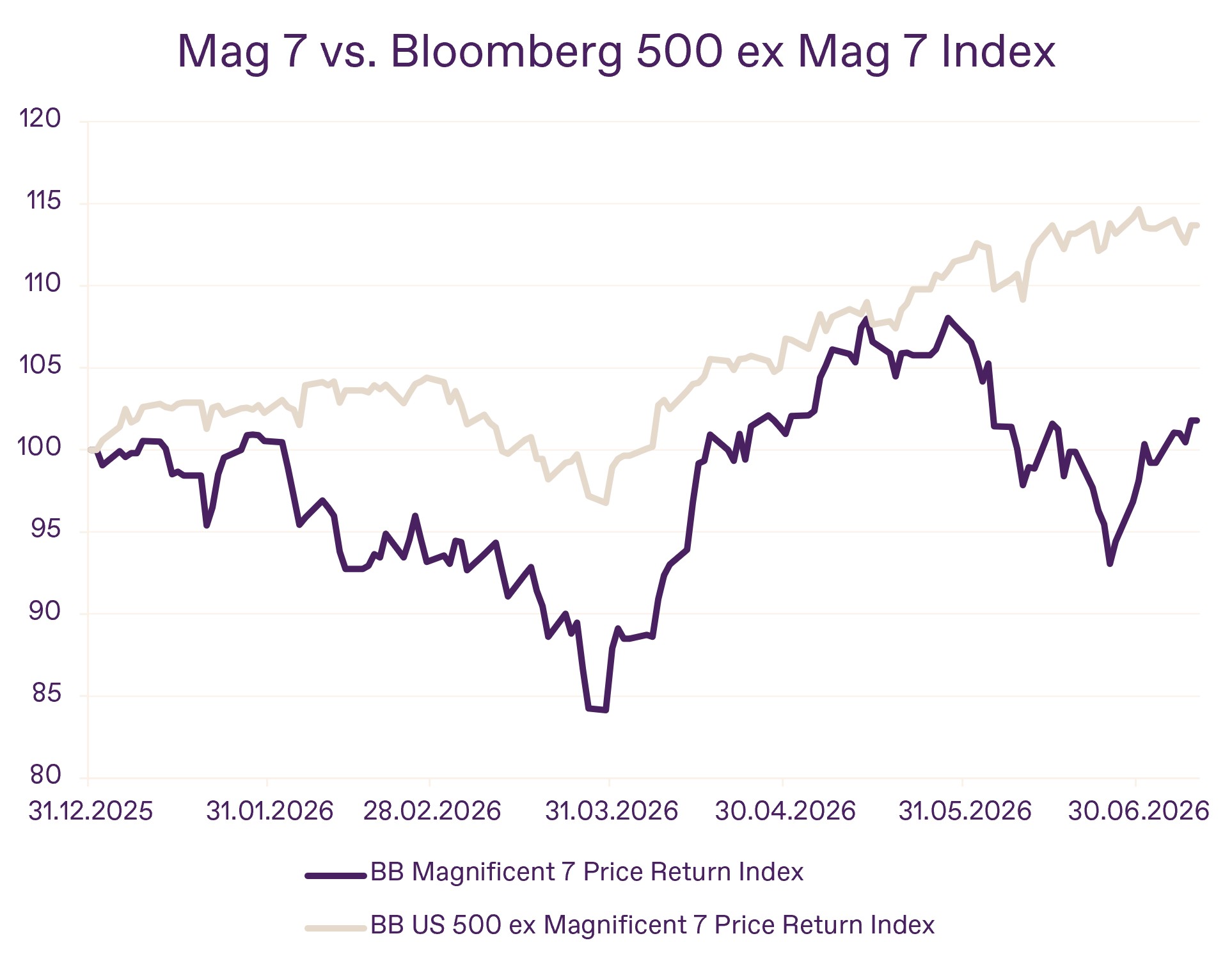
The following price chart shows the development of the Mag7 compared to the remaining 493 largest companies in the Bloomberg US 500 Index since the beginning of 2026. The underperformance of the former stock market stars recently amounted to nearly 12 percent (Source: Bloomberg Finance LP, 9 July 2026).
Chart: MAG 7 Index vs Bloomberg 500 ex Mag 7 Index Quelle: Bloomberg, 9.7.2026
On average, according to analyst estimates, the earnings of the companies in the Mag7 index are also expected to grow more strongly in 2027 than the overall index excluding the Mag7 (BB US 500 ex Mag7). However, if Nvidia is excluded from this consideration, the expected earnings growth is already a few percentage points below that of the BB US 500 ex Mag7.
Many investors also critically question the substantial investments made by the so-called hyperscalers. Alphabet, Amazon, Microsoft, and Meta have planned investments of more than 700 billion US dollars for this year, approximately half of which are financed through debt (Source: Bloomberg News, 9 July 2026).
Broad-based development
Although the performance of the Mag7 still strongly influences the performance of various indices due to their market capitalization, we have observed broader market participation since the beginning of the year, meaning that more companies in the index contribute to price performance.
Driven by the artificial intelligence (AI)-fueled boom in data centers, stocks from other sectors such as industrials and utilities have also gained momentum. Additionally, the rise in oil prices due to the Iran conflict has temporarily brought oil and gas companies back into the focus of investors. Instead of being driven by a handful of trillion-dollar tech companies, profits have expanded for many companies in the index.
An analysis by our research partner Ned Davis Research ("Percentage of S&P 500 Stocks Outperforming the S&P 500 over the Calendar Year," 9 July 2026) shows that in the first half of 2026, more than 44 percent of stocks in the S&P 500 index outperformed the index. This figure is 13 percentage points higher than in the previous year.
Our investment strategy
A selective approach to stock selection is therefore, in our view, essential. In our equity portfolios, we follow a well-founded selection process that considers company metrics, analyst estimates, and technical indicators.
We also avoid concentration in a few stocks, sectors, or themes (such as artificial intelligence or defense), as this can lead to significant cluster risk. In the so-called "Magnificent 7" stocks, we are significantly underweighted both in actively managed US portfolios and in global portfolios.
Disclaimer
This document is a marketing communication of Kathrein Privatbank Aktiengesellschaft pursuant to the Austrian Securities Supervision Act 2018 and serves exclusively informational purposes. The information aims to provide a general overview of current market data and Kathrein's market opinion and does not constitute a direct or indirect recommendation for a specific investment strategy in the sense of financial analysis. Investing in securities involves price fluctuations due to market changes at any time. Data and presentations referring to the past do not allow reliable conclusions about future results. Despite careful research and recording, no liability or guarantee can be assumed for the accuracy of the data.