Why Software is Facing a Hard Landing
12.02.2026
Why Software is Facing a Hard Landing



Author - Florian König
The sell-off in tech stocks last week did not come as a complete surprise. The thesis "AI eats software," loosely translated as "Artificial Intelligence (AI) makes software obsolete," has been causing unrest among investors for several months. Are the advancements in artificial intelligence now becoming a downfall for software companies? For some time, several software applications, business models, and subsequently entire companies have been facing a dilemma: Will the promised productivity gains, efficiency increases, and associated cost reductions potentially make them obsolete? Are the billions of investments by some companies now leading to the downfall of previously successful software firms? This question has evidently crossed the minds of investors around the globe. As a result, software companies came under pressure and faced painful declines in their stock prices.
Sentiment vs. Fundamentals
A significant contributor to the rapid shift in sentiment on the stock markets was the recent introduction of features from a co-working tool developed by the AI company Anthropic PBC. This tool is said to be capable of handling even complex tasks—from data analysis to legal tasks. These speculations, of course, occur without a fundamental basis. Panic took the reins and led to a swift sell-off of exposed companies. However, the last decade has been quite favorable for software companies, and the current outlook seems to factor in solid growth prospects. There may be less consensus regarding future growth expectations and how advancements in AI will impact them. Even companies that report better-than-expected results do not experience a positive change in sentiment if they cannot convincingly demonstrate that AI presents an opportunity and not a risk to their business model. It is also overlooked that even AI agents rely on software applications to perform specific tasks. The fact that software companies, which should have benefitted from productivity increases, are also affected by a severe sell-off illustrates impressively the erratic and uncertain environment we currently face in connection with AI.
Volatility Persists
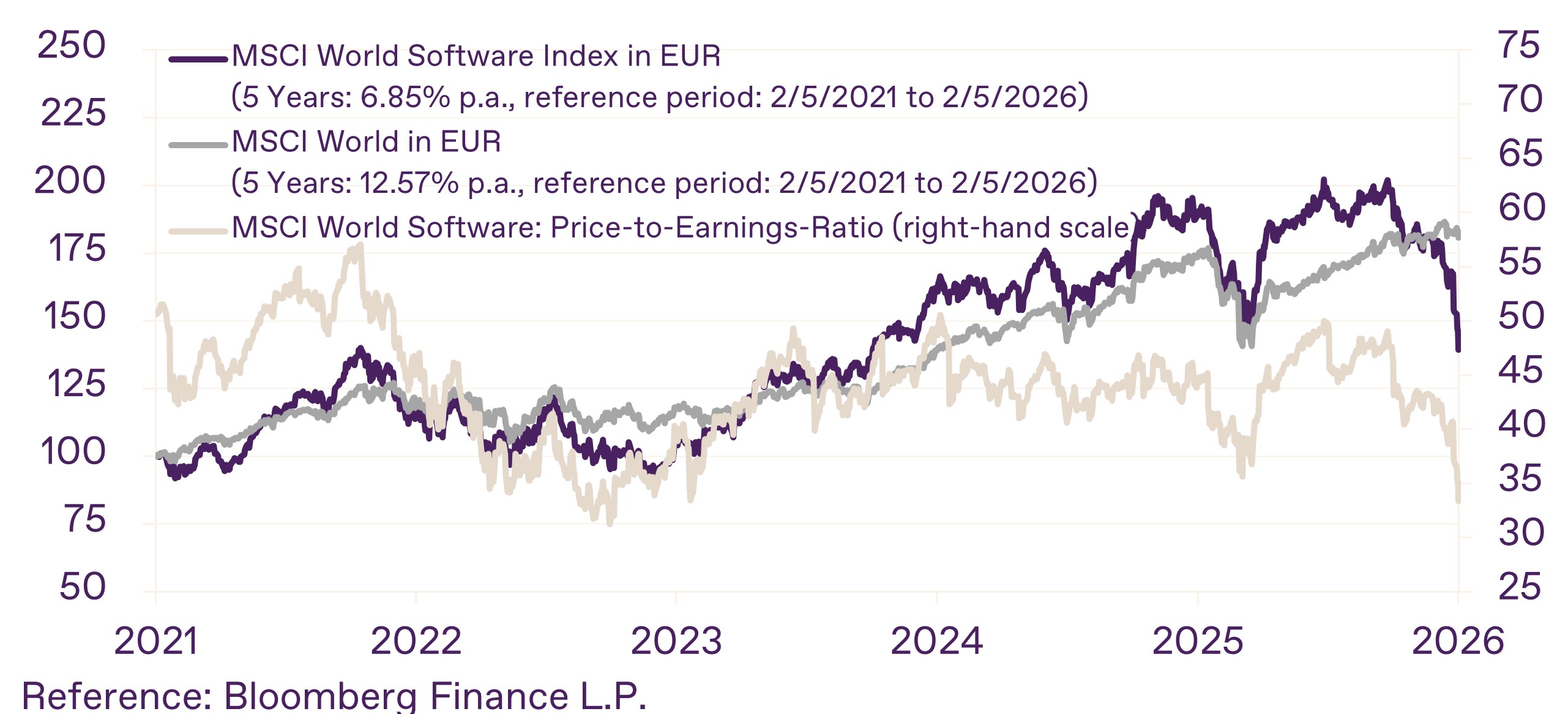
On Friday, February 6, an eight-day correction of the MSCI World Software Index came to an end. A sense of calm returned. The movement had appeared excessive and too intense by that point. This followed a decline of more than 16.5% from January 23, 2026, to February 5, 2026 (Source: Bloomberg Finance L.P.)—quite significant compared to the MSCI World Index's decrease of 1.22%. Over the past five years, the MSCI World Software Index has gained approximately 39.3% (6.85% p.a., period: February 5, 2021, to February 5, 2026, Source: Bloomberg Finance L.P.). The recent movements and those from previous weeks have negated the relative outperformance against the overall market during this period, which increased by more than 80%. The price-to-earnings ratio of the MSCI World Software Index fell to around 34, a level last observed in early 2023. Whether companies will experience a similar recovery as they did around Liberation Day in April 2025 remains uncertain. Sustainable skepticism could hinder this movement. Volatile waters seem to have been reached.
Graph: Comparison MSCI World vs MSCI World Software Index incl P/E of MSCI World Software Index
Productivity Not Guaranteed
The achievements of AI companies are undoubtedly remarkable and cause astonishment among other things. There is no question that this will, in some way, be accompanied by creative destruction. However, who the big winners will be cannot be predicted. In the past, it has been observed that technological advancements often did not lead to the expected productivity increases, particularly in the service sector. This thesis is attributed to the productivity paradox of Nobel laureate Robert Solow. The slow integration of new technologies, along with errors made during this process, hampers the potential for greater productivity. How AI will interact with software in the future, which companies will succeed, and in which countries the greatest progress will be made—all of this remains unclear and creates uncertainty for investors.
Kathrein Investment Strategy
Overall, we still consider a constructive market environment to be in place. Interest rates are lower than in previous years, which could positively impact economic growth. Regarding the tech giants, we have been positioned more cautiously for some time. We are also less exposed to the software industry. This is less due to concerns about an AI bubble and more based on strengthening the idea of diversification, reducing concentration risk, and identifying opportunities outside this sector. Compared to the US stock market, we are also less exposed than in comparison to the global MSCI ACWI Index. We have allocated capital in favor of the European stock market. In terms of the US dollar, we continue to rely on active management and a reduction of US dollar foreign exchange risk in our equity and bond portfolio.
Disclaimer
This is a marketing communication from Kathrein Privatbank Aktiengesellschaft in accordance with the Securities Supervision Act 2018 and is intended solely for informational purposes. This information aims to provide a general overview of current market data and the market opinion of Kathrein and does not constitute a direct or indirect recommendation for a specific investment strategy in the sense of a financial analysis. When investing in securities, price fluctuations due to market changes are always possible. Data and representations regarding the past do not allow for reliable conclusions about future results. Despite careful research and compilation, no liability or guarantee can be assumed for the accuracy of the data.